Time Period: 2nd Century (A.D. 107)
Position: Third Patriarch/Bishop of Antioch
Location: Antioch
Important works: Letter to the Ephesians, Letter to the Magnesians, Letter to the Trallians, Letter to the Romans, Letter to the Philadelphians, Letter to the Smyrnaeans, Letter to Polycarp
Language: Greek
St. Ignatius lived during the reign of Trajan. He is considered an Apostolic Father because he was a hearer of St. John the Apostle. On his way from Antioch to martyrdom in Rome (the beasts in the arena...fun), he wrote seven letters which are his only extant writings.
My professor pointed out to us that Ignatius was a grown man before Peter left Antioch--he was middle-aged when Peter was still alive! Striking!
It is in Antioch where the followers of Christ were first called Christians.
An Episcopal note: (Episcopal meaning "Bishop"--not having anything to do with the Episcopalian Church as such)Rome was not involved in the selection of bishops outside of the Roman diocese until after the Protestant movement. They were usually elected by priests at the Cathedral.
Here are some selections from each of the 7 Letters:
1. To the Ephesians...
For Jesus Christ, our inseparable life, is the will of the Father, just as the bishops, who have been appointed throughout the world, are at the will of Jesus Christ. It is fitting, therefore, that you should live in harmony with the will of the bishop--as, indeed, you do. Let us be careful, then, if we would be submissive to God, not to oppose the bishop.
It is clear, then, that we must look upon the bishop as the Lord Himself.
Here's another one, this I particularly enjoy...
There is one Physician, who is both flesh and spirit, born and not born, who is God in man, true life in death, both from Mary and from God, first able to suffer and then unable to suffer, Jesus Christ our Lord.
Give ear to the bishop and to the presbytery with an undivided mind, break one Bread, which is the medicine of immortality, the antidote against death, enabling us to live forever in Jesus Christ.
Note: This recalls John 6. The Eucharist and the Resurrection are bound together. Eating His flesh results in being raised up.
2. To the Magnesians...
Take care, therefore, to be confirmed in the decrees of the Lord and the Apostles, that in all things whatsoever you may prosper, in body and in soul, in faith and in love, in the Son and the Father and the Spirit, in the beginning and the end, together with your most reverend bishop and with your presbytery--that fittingly woven spiritual crown! --and with your deacons, men of God. Submit to the bishop and to each other's rights, just as did Jesus Christ in the flesh to the Father, and as the Apostles did to Christ and the Father and the Spirit, so that there may be unity both of flesh and of spirit.
3. To the Trallians...
It is necessary, therefore,--and such is your practice,-that you do nothing without the bishop, and that you be subject also to the presbytery, as to the Apostles of Jesus Christ our hope, in whom we shall be found, if we live with Him.
In like manner let everyone respect the deacons as they would respect Jesus Christ, and just as they respect the bishop as a type of the Father, and the presbyters as the council of God and the college of the Apostles. Without these, it cannot be called a Church.
Nota bene: I believe my friend James' conversion to the Church from Anglicanism was sped up after reading Ignatius if I remember correctly. I can see why. It's pretty clear. Also, this is why Catholics do not consider schismatics Churches but rather, ecclesial communities.
4. To the Romans... (considered his most important Letter)
I love this...
Only pray for me that I may have strength both inward and outward, that I may not merely speak, but have also the will; that I may not only be called a Christian but may also be found to be one. For if I be found to be one, I may also be called one, and be then deemed faithful, even when I am no longer visible. Nothing visible is eternal.
The Letter to the Romans is a treasure. If you had to pick one, this is it.
5. To the Philadelphians...
Those, indeed, who belong to God and to Jesus Christ--they are with the bishop.
And as many as shall, in the exercise of repentance, return into the unity of the Church, these, too, shall belong to God, that they may live according to Jesus Christ. Do not err, my brethren. If any man follows him that makes a schism in the Church, he shall not inherit the kingdom of God. If any one walks according to a strange opinion, he agrees not with the passion.
Take heed, then, to have but one Eucharist. For there is one flesh of our Lord Jesus Christ, and one cup to show forth the unity of His blood; one altar; as there is one bishop, along with the presbytery and deacons, my fellow-servants: that so, whatsoever you do, you may do it according to the will of God.
6. To the Smyrneans...
Let that be considered a valid Eucharist which is celebrated by the bishop, or by one whom he appoints. Wherever the bishop appears, let the people be there; just as wherever Jesus Christ is, there is the Catholic Church.
Nota bene: This is the first time the word Catholic is used in print!
7. Letter to Polycarp
This is helpful for me:
Become more diligent than you are. Observe well the times. Look for Him that is above seasons, timeless; invisible, yet, for our sakes, becoming visible; who cannot be touched; who cannot suffer, yet, for our sakes, accepted suffering, and who on our account endured everything.
(Beautiful, no?)
I end with this from his last letter...
Be long-suffering with one another and gentle, just as God is with you.
May I rejoice in you always.
+ + +
Thursday, July 23, 2009


Barnabas
Time Period: 1st Century
Position: Paul's companion on his 1st Missionary Journey
Location: Speculated to have an Alexandrian origin
Important works: Letter of Barnabas (either A.D. 70/79 or 117/132)
Language: Greek
The Letter is actually a theological tract and it does not give us information as to whether Barnabas is the authentic author.
Here are a couple of selections I would like to share with you:
And when He chose His own Apostles, who were about to preach His gospel, He chose men who were the worst kind of sinners in order to show that He came not to call the righteous but sinners (Mark 2:17)--and then He showed Himself to be the Son of God.
Check this out...I love this...
If He had not come in the flesh, there would be no way in which men could be saved by beholding Him: for even when they look at the sun, a work of His hands and a thing destined to perish, are they able to gaze straight into its rays?
For this reason, then, the Son of Man came in the flesh: to fill to the brim the measure of the sins of those who persecuted His prophets to death.
The author of this tract, like Clement, also gives the exhortation:
You shall not make a schism; but you shall pacify and bring together those who are quarreling. You shall confess your sins. You shall not go up to pray in the consciousness of having done evil. This is the way of light.
My notes:
It occurred to me in reading this that the method of by which our Lord educates us is through relationship. Relationship with Him and now relationship with Him through the Church: you and me. If the pillar of Protestantism, Sola Scriptura, were true, then I would think Jesus Christ would have spent His time writing, instead of hanging out with His disciples so much. Just a thought. Makes sense to me.
+
Position: Paul's companion on his 1st Missionary Journey
Location: Speculated to have an Alexandrian origin
Important works: Letter of Barnabas (either A.D. 70/79 or 117/132)
Language: Greek
The Letter is actually a theological tract and it does not give us information as to whether Barnabas is the authentic author.
Here are a couple of selections I would like to share with you:
And when He chose His own Apostles, who were about to preach His gospel, He chose men who were the worst kind of sinners in order to show that He came not to call the righteous but sinners (Mark 2:17)--and then He showed Himself to be the Son of God.
Check this out...I love this...
If He had not come in the flesh, there would be no way in which men could be saved by beholding Him: for even when they look at the sun, a work of His hands and a thing destined to perish, are they able to gaze straight into its rays?
For this reason, then, the Son of Man came in the flesh: to fill to the brim the measure of the sins of those who persecuted His prophets to death.
The author of this tract, like Clement, also gives the exhortation:
You shall not make a schism; but you shall pacify and bring together those who are quarreling. You shall confess your sins. You shall not go up to pray in the consciousness of having done evil. This is the way of light.
My notes:
It occurred to me in reading this that the method of by which our Lord educates us is through relationship. Relationship with Him and now relationship with Him through the Church: you and me. If the pillar of Protestantism, Sola Scriptura, were true, then I would think Jesus Christ would have spent His time writing, instead of hanging out with His disciples so much. Just a thought. Makes sense to me.
+
St. Clement of Rome
Whatever possessed me to take two summer school classes, I do not know. I already have finals next week (God help me). I'll be blogging on the Fathers as my method of studying. Happy reading!
Time Period:1st Century; cannot be later than the 90s
Position: Bishop of Rome (a.k.a. The Pope, third successor of St. Peter)
Location:Rome
Important works: Letter to the Corinthians (A.D. 80)
Language: Greek
This is the only surviving writing of Clement. He wrote the Letter as a response to the Bishop of Corinth being overthrown and the ensuing schism. It is interesting (as well as important) to note that when he wrote this, St. John the Apostle was still alive. But since Clement, not John, was the Bishop of Rome, the Pope, the appeal went to Rome.
He writes...
And our Apostles knew through our Lord Jesus Christ that there would
be strife over the name of the bishop's office. For this cause therefore, having received complete foreknowledge, they appointed the aforesaid persons, and afterwards they provided a continuance, that if these should fall asleep, other approved men should succeed to their ministration. Those therefore who were appointed by them, or afterward by other men of repute with the consent of the whole Church, and have ministered without blame to the flock of Christ in lowliness of mind, peacefully and with all modesty, and for long time have borne a good report with all these men we consider to be unjustly thrust out from their ministration.
(Translation: Apostolic Succession !)
He continues...
It is shameful, dearly beloved, yes, utterly shameful and unworthy of
your training in Christ, that it should be reported that the very
steadfast and ancient Church of the Corinthians, for the sake of one
or two persons, is in revolt against its presbyters.
(Translation: Schism: Bad ; Unity: Good !)
Further...
You, therefore, who laid the foundations of the rebellion, submit to the presbyters and be chastened to repentance, bending your knees in a spirit of humility.
Is there really anything more I can add to Clement? He makes it very clear that going against your bishop is a no-no, what gives legitimacy to the bishop is the unbroken apostolic succession (keep in mind, this is 80 A.D.--the Bible hadn't dropped from the sky yet!), and that you put yourself in danger when you create a schism. (He writes, "By your folly you heap blasphemies on the name of the Lord, and create a danger for yourselves.") Most significantly, this is coming from the authority of the Pope, who St. John himself submits to...because he submits to Christ who gave this instruction and power in the first place as recorded in the gospel of Matthew.
+
Time Period:1st Century; cannot be later than the 90s
Position: Bishop of Rome (a.k.a. The Pope, third successor of St. Peter)
Location:Rome
Important works: Letter to the Corinthians (A.D. 80)
Language: Greek
This is the only surviving writing of Clement. He wrote the Letter as a response to the Bishop of Corinth being overthrown and the ensuing schism. It is interesting (as well as important) to note that when he wrote this, St. John the Apostle was still alive. But since Clement, not John, was the Bishop of Rome, the Pope, the appeal went to Rome.
He writes...
And our Apostles knew through our Lord Jesus Christ that there would
be strife over the name of the bishop's office. For this cause therefore, having received complete foreknowledge, they appointed the aforesaid persons, and afterwards they provided a continuance, that if these should fall asleep, other approved men should succeed to their ministration. Those therefore who were appointed by them, or afterward by other men of repute with the consent of the whole Church, and have ministered without blame to the flock of Christ in lowliness of mind, peacefully and with all modesty, and for long time have borne a good report with all these men we consider to be unjustly thrust out from their ministration.
(Translation: Apostolic Succession !)
He continues...
It is shameful, dearly beloved, yes, utterly shameful and unworthy of
your training in Christ, that it should be reported that the very
steadfast and ancient Church of the Corinthians, for the sake of one
or two persons, is in revolt against its presbyters.
(Translation: Schism: Bad ; Unity: Good !)
Further...
You, therefore, who laid the foundations of the rebellion, submit to the presbyters and be chastened to repentance, bending your knees in a spirit of humility.
Is there really anything more I can add to Clement? He makes it very clear that going against your bishop is a no-no, what gives legitimacy to the bishop is the unbroken apostolic succession (keep in mind, this is 80 A.D.--the Bible hadn't dropped from the sky yet!), and that you put yourself in danger when you create a schism. (He writes, "By your folly you heap blasphemies on the name of the Lord, and create a danger for yourselves.") Most significantly, this is coming from the authority of the Pope, who St. John himself submits to...because he submits to Christ who gave this instruction and power in the first place as recorded in the gospel of Matthew.
+
Tuesday, June 30, 2009
Patristics-The Didache
I'm also taking a Patristics (the early Church fathers' writings)class this summer. We are reading selections from William A. Jurgens book The Faith of the Early Fathers: Volume 1-3.
The first ancient text we discussed was the Didache, known as the "teaching of the twelve." The original was lost until 1883 and most likely written around 80 A.D. when the apostles were still alive and spreading the Gospel. (If you want to argue with this date, my professor recommends John A.T. Robinson's work, Redating the New Testament.)
Unlike today's evangelization techniques, the early Christians searched out the people who were morally serious to introduce and propose the Christian Faith. The first thing the Didache did was to confront morality. Catechesis was first on morals and then led to the sacraments. The sacraments were the end game, not the starting point.
I like how the Didache begins, it's very blunt:
There are two ways, one of life and one of death: and great is the difference between the two ways.
A really interesting point the Didache makes is to be intelligent in your charitable giving decisions:
Let your alms perspire in your hands, until you know to whom you are giving.
Try this on for size:
You shall not procure abortion, nor destroy a new-born child.
This is from the *earliest* non-canonical apostolic writing--in case you needed that. Otherwise, it should be so utterly morally obvious to oppose the intentional murdering of innocents.
The sentence right before:
You shall not use potions.
Potions for what, you ask?
In the very promiscuous Greek culture, there were two types of potions: love potions and (drum roll) contraceptive potions.
Interesting. All along the Catholic Church (and only only only the Catholic Church!) has related the widespread use of contraception to the increase in abortions. (Not to mention affairs, domestic violence, divorce, etc. etc. etc.) And here, this oldest document of the apostles, mentions them one after the other.
First comes contraception, then abortion.
(If you need more education/formation on this topic regarding the Catholic Church's teaching, I highly recommend Janet Smith's audio CD "Contraception: Why Not?" You can order it for FREE!)
The Didache is a treasure and there are many nuggets in the work, I leave you with one of them:
Whoever, therefore, comes and teaches you all these things that have been said before, receive him. But if the teacher himself turns and teaches another doctrine to the destruction of this, hear him not.
I would find this troubling were I a Protestant today.
Our Lady, Seat of Wisdom, pray for us. +
The first ancient text we discussed was the Didache, known as the "teaching of the twelve." The original was lost until 1883 and most likely written around 80 A.D. when the apostles were still alive and spreading the Gospel. (If you want to argue with this date, my professor recommends John A.T. Robinson's work, Redating the New Testament.)
Unlike today's evangelization techniques, the early Christians searched out the people who were morally serious to introduce and propose the Christian Faith. The first thing the Didache did was to confront morality. Catechesis was first on morals and then led to the sacraments. The sacraments were the end game, not the starting point.
I like how the Didache begins, it's very blunt:
There are two ways, one of life and one of death: and great is the difference between the two ways.
A really interesting point the Didache makes is to be intelligent in your charitable giving decisions:
Let your alms perspire in your hands, until you know to whom you are giving.
Try this on for size:
You shall not procure abortion, nor destroy a new-born child.
This is from the *earliest* non-canonical apostolic writing--in case you needed that. Otherwise, it should be so utterly morally obvious to oppose the intentional murdering of innocents.
The sentence right before:
You shall not use potions.
Potions for what, you ask?
In the very promiscuous Greek culture, there were two types of potions: love potions and (drum roll) contraceptive potions.
Interesting. All along the Catholic Church (and only only only the Catholic Church!) has related the widespread use of contraception to the increase in abortions. (Not to mention affairs, domestic violence, divorce, etc. etc. etc.) And here, this oldest document of the apostles, mentions them one after the other.
First comes contraception, then abortion.
(If you need more education/formation on this topic regarding the Catholic Church's teaching, I highly recommend Janet Smith's audio CD "Contraception: Why Not?" You can order it for FREE!)
The Didache is a treasure and there are many nuggets in the work, I leave you with one of them:
Whoever, therefore, comes and teaches you all these things that have been said before, receive him. But if the teacher himself turns and teaches another doctrine to the destruction of this, hear him not.
I would find this troubling were I a Protestant today.
Our Lady, Seat of Wisdom, pray for us. +
Monday, June 29, 2009
Old Testament Week I, Class I

I'm taking a class on the Old Testament this summer for six weeks. I'm going to be taking notes on this blog in case it will be of service to anyone reading.
Besides the Bible, we are also reading Scott Hahn's book A Father Who Keeps His Promises: God's Covenant Love in Scripture.
Recommended books for educators, or future educators (that's me, God-willing!) is Antonio Fuentes' Guide to the Bible and The Scripture Documents: An Anthology of Official Catholic Teaching. The latter is particularly interesting to me. As St. Jerome said, "Ignorance of Scriptures is ignorance of Christ." But also, ignorance of the Church is ignorance, or maybe even worse, misinterpretation of the Scriptures. Remember, the Universal Church gave us the Bible and the Bible is part of the Tradition of the Church. No Church, no Bible.
One last note, in my Bible (Revised Standard Version, Second Catholic Edition--the best translation) are two inserts: The Bible Timeline: The Story of Salvation (Thank you, Mother!) and a Bible Map Insert (Thank you, Professor!).
The Bible contains 73 books, but if you are going to read the Bible with a chronological approach, there are 14 at the core.
Alright, back to my class. Since I've been pretty lazy about note-taking (I'd rather pay attention than labor for notes), here are some of my randomly selected notes from my first day:
1. Mosaic authorship of the first five books of the Bible. The "Torah" in Hebrew, the "Pentateuch" in Greek.
2. To understand Genesis, one must understand Exodus.
3. In Biblical numerology, seven is the number symbolizing perfection. The Hebrew word "Sheva" (Seven) is the word for "swear." When you swear in an oath (to God), you are "sevening" yourself.
4. St. Ephraim the Syrian's commentary is the most important on the Pentateuch.
5. Contrary to popular belief, there were two "special" trees in Eden: the tree of life and the tree of the knowledge of good and evil. The latter's fruit was forbidden. Some theologians have surmised that eventually Adam and Eve would have been permitted to eat of its fruit, but disobeyed eating prematurely and against God's command.
6. The Hebrew word for "helper" is azar which translates into helper, counselor, adviser, partner, perfect match.
7. Eve is equal to Adam implied in his words, "This at last is bone of my bones and flesh of my flesh..."
Friday, June 26, 2009
Holy Land Pilgrimage May 4-15, 2009 Part II
Itinerary by Ann Vucic with my edits (Click on the links for images)*This is incomplete; I'll be adding more personal anecdotes in the weeks to follow.*
Day 1: Monday, May 4
Depart USA for Tel Aviv, via Madrid. For those of us flying from Chicago, we flew aboard a plane called the “Teresa de Avila."
A good omen for the beginning of our pilgrimage.
Day 2: Tuesday, May 5
Arrive Tel Aviv. Our local guide, Fr. David Wathen, OFM greets us at the airport. We travel together from Ben Gurion Airport to the northern part of Israel. On the way we took a detour on a dirt road due to road issues. Arrived at Mount of Beatitudes Guest House in late evening, had dinner and checked in.
For those who had some energy left after the long journey, Fr. Jim Livingston, our spiritual director, celebrated Mass in the Guest House chapel.
Day 3: Wednesday, May 6
Morning
After breakfast, we went to our first site, the shrine of the Primacy of Peter. It was a simple little church, right on the shores of the Sea of Galilee, with a large rock inside of the church, with the words “Mensa Christi” (which means: table of Christ) written on it. This site is the setting for a few significant Gospel stories. It is a post-resurrection site, where Jesus prepared a meal for His apostles on a rock, while they were fishing on the Sea. It is also where Jesus asked Peter three times “Do you love me?” (in response to his having denied Jesus three times) and where Peter was instructed to feed the Lord’s sheep, establishing his primary role among the apostles, hence the title “Primacy of Peter” for this shrine. We had Mass at an outdoor altar, with a backdrop of a mosaic of Pope John Paul II. After Mass, we had some free time to spend along the shores of the Sea of Galilee.
After that, we drove to the Golan Heights, in the northeast part of Israel, to visit Caesarea Philippi. This site is now an Israeli National Park. It includes the Banias Springs and the ancient pagan Temple of Pan. Jesus used the natural land formations here as a teaching tool. There is a HUGE rock there, and a deep cave, and the ancients used to believe that caves were the gates to the netherworld. It was at this site that Jesus asked Peter “Who do you say that I am?” And when Peter responded with the truth of Jesus’ identity, Jesus said to him: “you are rock and upon this rock I will build my church and the gates of hell shall not prevail against it.” It was here that Peter was established as the first Pope. There is also a spring at this site, and it is one of the 3 sources of water that together create the Jordan River.
Afternoon
Near Caesarea Philippi we had lunch at a local little “fast food” place run by a Druze family. As Fr. David explained to us, the Druze are a secretive, tightly-knit religious sect, and are an offshoot of Islam. They believe that God became incarnate in the form of their leader, al-Hakim bi-Amrih Alla. The Druze do not have their own homeland, so many of them migrated to the isolated mountains of Lebanon, Syria, and Israel, while others settled throughout the Middle East.
After lunch we drove to a lookout point where you could see the country of Syria, and along the way, we recalled the story of the conversion of Saul/Paul on the road to Damascus (Syria).
Then we returned to the Sea of Galilee area and went to Bethsaida, where three of the apostles were born. There were many ruins in Bethsaida, but no church. We sat down on some rocks and listened to Fr. David speak about this site.
Our final stop of the day was a boat ride on the Sea of Galilee, where we recalled the stories about Jesus on the Sea of Galilee. Then our boat crew entertained us with some Israeli songs.
Evening
Returned to Mount of Beatitudes for dinner. After dinner, we had a “beginning of pilgrimage meeting” so that we could introduce ourselves to each other and share a little bit about ourselves with one another.
Day 4: Thursday, May 7
Morning
Began our day in Cana of Galilee. It is the site where Jesus performed his first miracle when He attended the wedding feast. He changed the water into wine at the request of His mother Mary. The married couples in our group renewed their wedding vows.
After Cana we drove a short distance to Nazareth, to the Basilica of the Annunciation. It is where the angel Gabriel announced to Mary that she would conceive a child. We had Mass in front of the grotto of the annunciation, where it is believed that this event took place. Mass ended right at noon, so we took the opportunity to pray the Angelus together!
After Mass we walked a short distance across the courtyard, to the Church of St. Joseph, the site where it is believed that the Holy Family lived. We listened to some priests and sisters singing beautiful music in French, while we were waiting for them to finish their prayer time in the main chapel. It was a place where many in our group were able to write out prayer petitions and drop them through a grate in the ground, to the actual site below.
Afternoon
Lunch was at a restaurant in a kibbutz.
After lunch we drove to Mount Tabor, the site where the transfiguration of Our Lord happened. We spent some time inside the church and then Fr. David took us to a lookout point and pointed out some places where significant Biblical stories took place.
We returned to Mount of Beatitudes around 4:00 pm and had a few hours free time to just relax before dinner.
After dinner, a large group of us hung out in the sitting room near the dining room.
Day 5: Friday, May 8
Morning
Began our day with an outdoor Mass in a beautiful setting, right on the waters edge in Capernaum and then spent about 3 hours there. Capernaum was the home of Peter, and also the home of Jesus. It was in the synagogue that Jesus preached His Bread of Life discourse (John 6). Many other events in the life of Jesus happened in this town. Fr. David held his own discourse for us and answered many questions. Very relaxing, leisurely morning.
Next we went to Tabgha, to the church that commemorates the Multiplication of the Loaves and Fishes. It is a simple little church that has the famous mosaic on the floor under the altar. It was the place where the woman was setting up a little fish pond in the courtyard, and was putting the fish into it while we were there. We stayed there only a brief time.
Afternoon
Lunch was at the restaurant where we were offered the St. Peter’s fish for lunch.
After lunch we drove to the southern end of the Sea of Galilee, to the Jordan River, where we renewed our baptismal vows.
We got back to Mount of Beatitudes around 4:00 pm, and had a few hours of free time before dinner.
Evening
After dinner, Fr. Jim led us in a healing service in the chapel. After the healing service, a large group of us hung out, first outside, then in the lobby for a few hours.
Day 6: Saturday, May 9
Morning
Our day began with Mass at the outdoor altar at the Mount of Beatitudes. After that, we checked out of the Guest House and began our journey down to Jerusalem.
We first went to the Mount of Temptation. We had to take the cable car up from Jericho to the Greek Orthodox Monastery at the top. In the monastery is the cave where it is believed that Jesus lived and slept while He was put to the test by Satan.
Afternoon
Lunch was at the Mount of Temptation restaurant in Jericho.
Then we drove through Jericho to see a Sycamore Tree, which reminds us of the story of Zaccheus climbing the Sycamore Tree in order to be able to see Jesus.
After that we drove to the Dead Sea and spent about an hour there.
After our visit to the Dead Sea, we continued our drive through the Judean desert, to Jerusalem, checked in to the Grand Court Hotel, and went to dinner.
Some of the group hung out together that evening in that cold meeting room that was just off of the reception desk.
Day 7: Sunday, May 10
Morning
We began our day at the Mount of Olives. First we visited the Chapel of the Ascension of the Lord, which is now under Moslem control and is actually a Mosque. There is an indentation on a stone slab on the ground that legend claims is the footprint of Jesus as He ascended to heaven.
Next we walked down to the Church of Dominus Flevit (which means “the Lord wept”). This site commemorates where Jesus
looked upon Jerusalem and wept. The little chapel at this site is built in the shape of a teardrop, but we were not able to go inside because another group was having Mass while we were there. From a lookout point just in front of the church, Fr. David pointed out the way that Jesus walked during His passion. Jesus began on Mount Zion (from where we were standing, Mount Zion was at the top of the hill across the valley, and to the left of the Old City), where he celebrated the Last Supper in the Upper Room, then He crossed the Kidron Valley to come to the Garden of Gethsemane, where He was arrested. The Kidron Valley is that little valley where the Papal venue was set up for the Mass in Jerusalem. From our vantage point at Dominus Flevit, Gethsemane was just below us. Next Jesus was taken to Caiaphas’s house, back across the Kidron Valley. This is the place we went to with Jimmy, the guide who replaced Fr. David. It was where we saw the dungeon that Jesus would likely have been kept overnight, and where we saw the Holy Stairs. From Caiaphas’s house, Jesus was brought into the Old City where He was brought before Pilate, and
then Pilate sent Him back to Caiaphas’s house, where He was kept overnight in the dungeon that we saw later. And then finally on Friday, Jesus was brought to the place where He began His Via Dolorosa – His Stations of the Cross, that led Him to Calvary now located in the Church of the Holy Sepulchre. We could see this entire path very clearly from where we were standing, at the Church of Dominus Flevit.
Next we walked the “Palm Sunday Road”, down to the Garden of Gethsemane. We took our group picture at this site, right in front of the grove of olive trees. Those olive trees are over 2,000 years old and are sometimes referred to as the “silent witnesses” of Christ's passion, since they were there when He suffered His agony in the garden. The church at Gethsemane is called the Church of All Nations, because many different countries contributed to its construction. It is also sometimes called the church of the Rock of Agony, because right in front of the main altar is the rock that it is believed that Jesus suffered His agony upon.
We then proceeded further down the Palm Sunday road, to the Tomb of Mary. It is believed that she died at the site of Dormition Abbey, across the Kidron Valley, on Mount Zion, but that her body was brought to this site for burial, and then from this site, she was assumed into heaven. To get to the Tomb of Mary, we descended down a long and wide staircase, to a darkened crypt area below, that contained the final resting place of the Mother of God.
Right next door to the Tomb of Mary, is a cave, called the Grotto of Gethsemane (the place where the apostles were a “stone’s throw away” from Jesus when he was suffering His agony in the garden). This cave was a regular meeting place for the apostles and Jesus when they were in Jerusalem, so it was natural that they went there on the night of the Last Supper. This grotto is also called the Grotto of Betrayal, because it is where Judas betrayed Jesus with a kiss. It was in this cave that Jesus was arrested. We celebrated Mass at this site.
Afternoon
In the afternoon we drove to Bethlehem, in the West Bank, through an Israeli checkpoint. First we had lunch at Ruth’s Restaurant, and then we went shopping at a pre-arranged store, Boaz's Field.
After shopping we went to Shepherd’s Field, right next door to the shop. Shepherd’s Field commemorates the place where the Angel appeared to the shepherds and announced to them the birth of the Christ Child.
Then we went to the Church of the Nativity, where Jesus was born. First we stood in line to enter the lower level grotto, where we were able to venerate the place where Jesus was born, which is marked by a silver star underneath an altar. Then we visited the church that is right next door (under the same roof), called St. Catherine’s, which is the Catholic parish of Bethlehem. It is from St. Catherine’s that Midnight Mass in Bethlehem is televised on Christmas Eve.
Next we went downstairs, underneath St.Catherine’s and the Church of the Nativity, to several grotto’s, the most important being the grotto of St. Jerome, where St. Jerome lived for many years and where he translated the Bible from Hebrew and Greek into Latin (called the Vulgate).
Evening
We left the West Bank and returned to Jerusalem. That evening, after dinner, we had a private holy hour in the Church of All Nations, at the Rock of Agony, with the church all to ourselves.
Day 8: Monday, May 11
Morning
Due to uncertainty about the Holy Father’s schedule and how it would impact our ability to get around Jerusalem in the coming days, Fr. David decided that we would spend the entire day walking through and around the Old City of Jerusalem (which normally would not be done all in one day).
We began the day very early (7:30 departure from hotel), and went first to the Western Wall, or Wailing Wall, as it is also sometimes called. The wall is the most sacred site in the world for Jews, because it is the only remaining part of their ancient (Solomon's) Temple that still exists. The Romans destroyed the temple in 70 A.D., and the site where it stood has been occupied by a Moslem shrine (the famous golden-domed structure), called the Dome of the Rock, since the late 7th century. It is called the Dome of the Rock because the shrine is built over a very large rock. For Jews this rock is sacred because they believe it is the site where Abraham was asked to sacrifice his son Isaac (Mt. Moriah), which was the reason that the Jewish people built their temple here. For Moslems this rock is sacred because they believe that it was from this rock that Mohammad made his “night journey” to heaven. Jews call this site “the Temple Mount”, and Moslems call it “Haram al Sharif”, meaning “the Noble Sanctuary”.
Next we walked to the Lion’s gate, also known as St. Stephen’s gate, to the Church of St. Anne, the site where parents of the Blessed Virgin Mary lived and where Mary was born. We venerated a cave in a little crypt area below the main church as the site where this event occurred, and then when we came back upstairs, we were greeted by the beautiful sounds of a group of Nigerian pilgrims singing "How Great Thou Art," in their native tongue. Right next to the church of St. Anne is the Pool of Bethesda, a site where some Gospel events occurred.
We then proceeded to the Chapel of Flagellation, where we were given a cross to carry, so that we could begin our Via Dolorosa, our own Stations of the Cross through the very crowded streets of Jerusalem. We meandered through the streets of the Old City, following the path that Jesus walked on His way to His crucifixion, and we concluded our journey at the Church of the Holy Sepulchre, where we visited the site of Calvary, the slab where His body was anointed when it was taken down from the cross, the tomb where He was laid…and rose from the dead! We also visited a few additional side chapels at the Church of the Holy Sepulchre. We descended down a few flights of stairs to the Chapel of the Holy Cross, where St. Helena found the True Cross. We visited the Chapel of Adam, which lies just below Calvary, and where you can see the rock of Calvary split in two, as was described in the Gospel accounts of Jesus’ crucifixion.
Afternoon
We then had lunch at an outdoor restaurant in the Old City, not far from the Church of the Holy Sepulchre.
After lunch, we walked through the Jewish quarter of the Old City, to reach Zion’s Gate, which we went through to get to Mount Zion. On Mount Zion we first went to the site of the Upper Room, where Polish people from the movement Neocatechumenal Way were singing! They seemed to be following us wherever we went which I did not mind because their language and singing is so beautiful. We moved to an outdoor area to listen to Fr. David speak to us about the Upper Room.
Next we had Mass at the Franciscan chapel in honor of the Blessed Sacrament (the place where we sat around in the enclosed garden area for about 30 minutes before Mass). As Fr. David explained to us, the Franciscans used to be the custodians of the actual Upper Room, but it was taken away from them 500 years ago. Because they did not have access to the Upper Room, they built this little chapel next door to as a place where they could commemorate the events that happened in the Upper Room.
(A side note: the Franciscans have been in intense negotiations with the State of Israel for quite a while now, in an effort to re-acquire ownership of the Upper Room)
After Mass, we walked over to Dormition Abbey, the traditional site where it is believed that the Virgin Mary “fell asleep”. The central focus of the Abbey is the statue of Mary lying down in her final resting position. After this, our final stop of the day, we walked the long way back to the bus, circling around the outside of the huge walls of the Old City.
Day 9: Tuesday, May 12
Morning
After a very exhausting Monday, we were more leisurely this day. The morning began with a drive to Ein Kerim, where Zacharias, Elizabeth and John lived. First we visited the Church of the Visitation, where Mary went to visit her cousin Elizabeth, and where Mary spoke those famous words of the Magnificat ("My soul proclaims the greatness of the Lord…"). These words are written on many different languages, on tiles that adorn the courtyard of the church. We visited both the lower church and the upper church. Then we walked back down the hill to visit the Church of St. John the Baptist, where we were able to venerate the place where John the Baptist was born, marked with a star underneath a small altar, to the left of the main sanctuary space.
Afternoon
We had lunch in the garden area of a Lebanese restaurant in Ein Kerim. We spent about 4 hours in Ein Kerim.
From Ein Kerim (west of Jerusalem), we drove to Bethany (east of Jerusalem), the town that Martha, Mary and Lazarus lived in and that Jesus frequently visited. Bethany is in the West Bank (though we did not need passports to get in and out of this part of the West Bank, as we did in Bethlehem). Bethany actually lies just on the other side of the Mount of Olives, about a mile or two from the site of Jesus’ Ascension, but there is now a wall that divides it. We had Mass at the church in Bethany. After Mass, we walked up the road a little way, to the site of Lazarus’s tomb, and we descended down into it. As we returned to the bus, there was a man with a camel waiting there for us, and so some of our pilgrims rode the camel. After that, we returned to Jerusalem for dinner.
Evening
Before dinner, some of the group decided to walk to where the Holy Father’s Mass was going to be. The group got as far as Lion’s Gate (also called St. Stephen’s Gate). The gate was blocked off, with Israeli soldiers stationed there. We were told that there was no way to get to the Papal Mass at that point, and no amount of begging changed that!
So the group decided to walk to the Church of the Holy Sepulchre, in hopes of being able to spend more quality time there. When we were there the day before, it was packed with pilgrims, so we were not able to go into the tomb, or touch the rock of Calvary. It was much quieter this evening and we were able to do all those things. Then we walked back to the hotel for dinner.
Day 10: Wednesday, May 13
Morning
We drove to Emmaus (Nicopolis) in the morning. Fr. David explained to us that there are three different possible sites for the story of the encounter between Jesus and His disciples on the road to Emmaus, and this was one of the possible sites. We had Mass at the beautiful little chapel at this site.
Afternoon
We returned to the hotel after this visit, and then we had to say goodbye to Fr. David. For lunch we split into two different groups. One group went to a pizza place close to the hotel, and the other group went to an outdoor restaurant located in the American Colony hotel, near our hotel.
In the afternoon, our new guide Jimmy joined us for the afternoon. First we drove to St. Peter Gallicantu. Gallicantu means the crowing of the cock, and it is called that because it is the site where Peter betrayed Jesus. St. Peter Gallicantu is believed to be location of the house of Caiaphas, and it is believed that Jesus was held here overnight in Caiaphas’ dungeon. We were able to see that dungeon, well intact. We also visited the “Holy Stairs”. These stairs date to well before Jesus’ time, and they were a main route through the city, so, as Jimmy put, “we are not 100% certain that Jesus walked on these stairs, we are 1000% certain that He did." We had to drive a roundabout route to get to St. Peter Gallicantu because the direct roads were still closed due to the Pope’s presence. Because we drove this route, Jimmy was able to point out a few places of Gospel significance that we passed along that route. First he showed us the plot of land that Judas purchased for the 30 pieces of silver that he was given to betray Jesus. It is also believed to be the place where Judas hanged himself after his action. He also pointed out to us the Pool of Salome, where Jesus sent the blind man to wash his eyes in, after he smeared a mixture of mud and spit on his eyes. After St.Peter Gallicantu, we drove over to the Mount of Olives, to visit the Church of the Pater Noster, which commemorates Jesus’teaching His disciples to pray the Our Father. There were over 100 large ceramic plaques with the words of the Our Father written in different languages adorning the walls. Then we returned to the hotel.
Evening
After dinner, we met in the courtyard area of our hotel for an end of the pilgrimage meeting, where we shared about our experiences on this pilgrimage.
Day 11: Thursday, May 14
Morning and Afternoon
Free time to do whatever we wanted.
In the late afternoon, we met at the Franciscan Chapel of the Blessed Sacrament, on Mount Zion, for our last Mass before departure.
After Mass, we went to the Christmas Hotel for a farewell dinner.
After that, some of the group decided to go to Ben Yehuda Street, partly to check out where the Israeli young people hang out in the evenings, and partly to stay awake for our very early morning departure for the airport.
Day 12: Friday, May 15
Departed Jerusalem at about 2:00 am for our long journey back home.
Day 1: Monday, May 4
Depart USA for Tel Aviv, via Madrid. For those of us flying from Chicago, we flew aboard a plane called the “Teresa de Avila."
A good omen for the beginning of our pilgrimage.
Day 2: Tuesday, May 5
Arrive Tel Aviv. Our local guide, Fr. David Wathen, OFM greets us at the airport. We travel together from Ben Gurion Airport to the northern part of Israel. On the way we took a detour on a dirt road due to road issues. Arrived at Mount of Beatitudes Guest House in late evening, had dinner and checked in.
For those who had some energy left after the long journey, Fr. Jim Livingston, our spiritual director, celebrated Mass in the Guest House chapel.
Day 3: Wednesday, May 6
Morning
After breakfast, we went to our first site, the shrine of the Primacy of Peter. It was a simple little church, right on the shores of the Sea of Galilee, with a large rock inside of the church, with the words “Mensa Christi” (which means: table of Christ) written on it. This site is the setting for a few significant Gospel stories. It is a post-resurrection site, where Jesus prepared a meal for His apostles on a rock, while they were fishing on the Sea. It is also where Jesus asked Peter three times “Do you love me?” (in response to his having denied Jesus three times) and where Peter was instructed to feed the Lord’s sheep, establishing his primary role among the apostles, hence the title “Primacy of Peter” for this shrine. We had Mass at an outdoor altar, with a backdrop of a mosaic of Pope John Paul II. After Mass, we had some free time to spend along the shores of the Sea of Galilee.

After that, we drove to the Golan Heights, in the northeast part of Israel, to visit Caesarea Philippi. This site is now an Israeli National Park. It includes the Banias Springs and the ancient pagan Temple of Pan. Jesus used the natural land formations here as a teaching tool. There is a HUGE rock there, and a deep cave, and the ancients used to believe that caves were the gates to the netherworld. It was at this site that Jesus asked Peter “Who do you say that I am?” And when Peter responded with the truth of Jesus’ identity, Jesus said to him: “you are rock and upon this rock I will build my church and the gates of hell shall not prevail against it.” It was here that Peter was established as the first Pope. There is also a spring at this site, and it is one of the 3 sources of water that together create the Jordan River.

Afternoon
Near Caesarea Philippi we had lunch at a local little “fast food” place run by a Druze family. As Fr. David explained to us, the Druze are a secretive, tightly-knit religious sect, and are an offshoot of Islam. They believe that God became incarnate in the form of their leader, al-Hakim bi-Amrih Alla. The Druze do not have their own homeland, so many of them migrated to the isolated mountains of Lebanon, Syria, and Israel, while others settled throughout the Middle East.
After lunch we drove to a lookout point where you could see the country of Syria, and along the way, we recalled the story of the conversion of Saul/Paul on the road to Damascus (Syria).
Then we returned to the Sea of Galilee area and went to Bethsaida, where three of the apostles were born. There were many ruins in Bethsaida, but no church. We sat down on some rocks and listened to Fr. David speak about this site.

Our final stop of the day was a boat ride on the Sea of Galilee, where we recalled the stories about Jesus on the Sea of Galilee. Then our boat crew entertained us with some Israeli songs.

Evening
Returned to Mount of Beatitudes for dinner. After dinner, we had a “beginning of pilgrimage meeting” so that we could introduce ourselves to each other and share a little bit about ourselves with one another.
Day 4: Thursday, May 7
Morning
Began our day in Cana of Galilee. It is the site where Jesus performed his first miracle when He attended the wedding feast. He changed the water into wine at the request of His mother Mary. The married couples in our group renewed their wedding vows.

After Cana we drove a short distance to Nazareth, to the Basilica of the Annunciation. It is where the angel Gabriel announced to Mary that she would conceive a child. We had Mass in front of the grotto of the annunciation, where it is believed that this event took place. Mass ended right at noon, so we took the opportunity to pray the Angelus together!

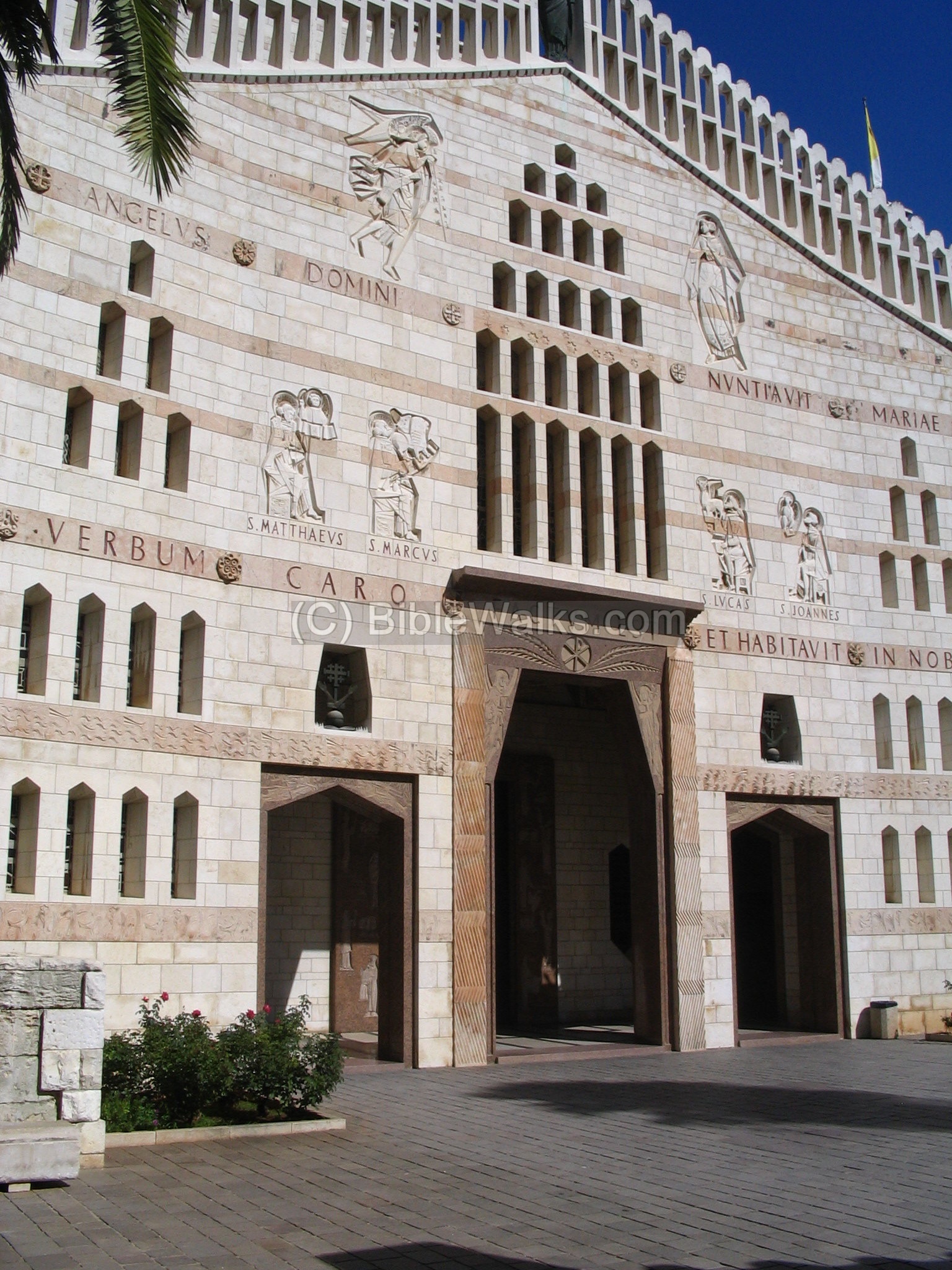
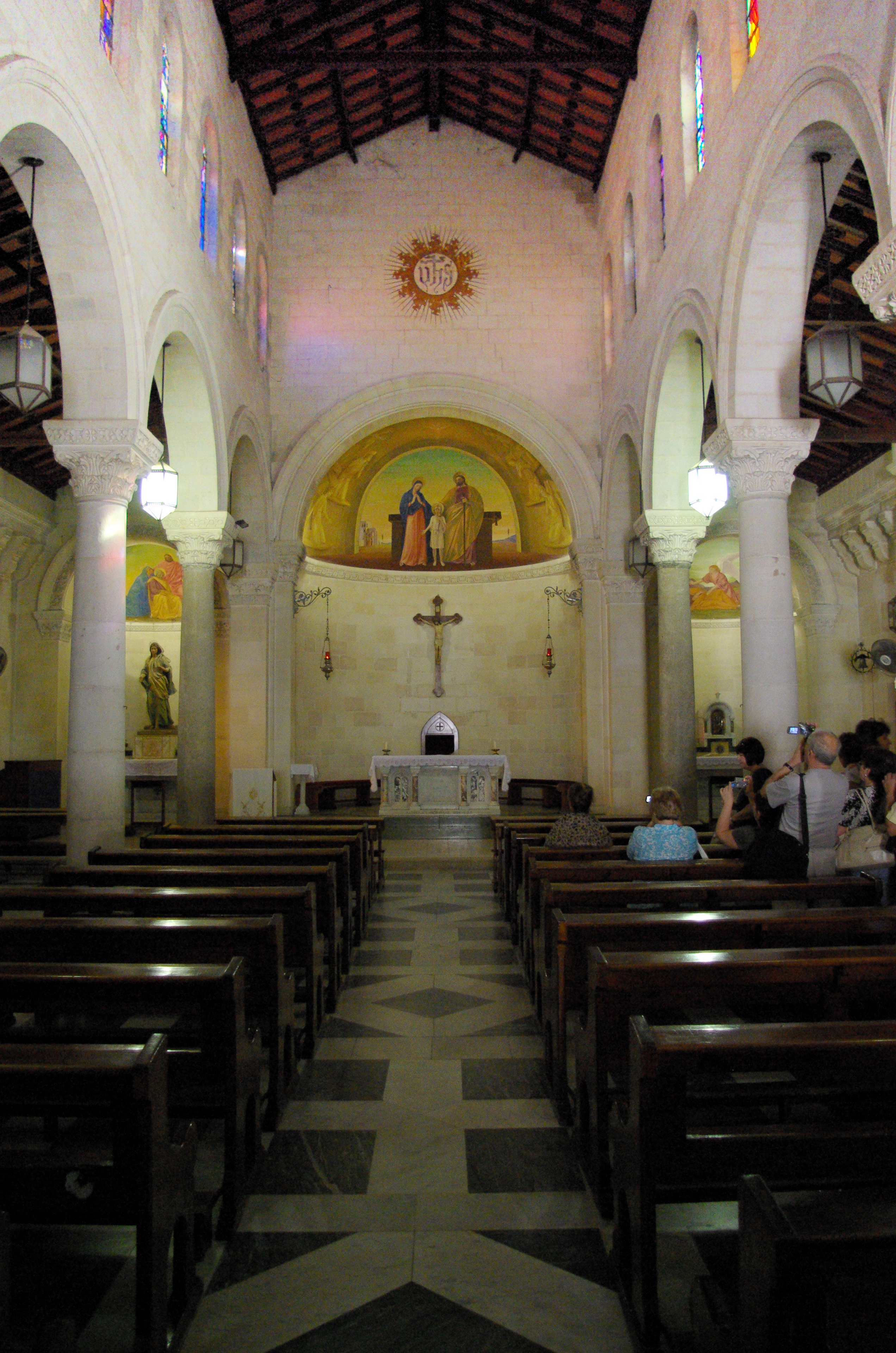
After Mass we walked a short distance across the courtyard, to the Church of St. Joseph, the site where it is believed that the Holy Family lived. We listened to some priests and sisters singing beautiful music in French, while we were waiting for them to finish their prayer time in the main chapel. It was a place where many in our group were able to write out prayer petitions and drop them through a grate in the ground, to the actual site below.
Afternoon
Lunch was at a restaurant in a kibbutz.
After lunch we drove to Mount Tabor, the site where the transfiguration of Our Lord happened. We spent some time inside the church and then Fr. David took us to a lookout point and pointed out some places where significant Biblical stories took place.


We returned to Mount of Beatitudes around 4:00 pm and had a few hours free time to just relax before dinner.

After dinner, a large group of us hung out in the sitting room near the dining room.
Day 5: Friday, May 8
Morning
Began our day with an outdoor Mass in a beautiful setting, right on the waters edge in Capernaum and then spent about 3 hours there. Capernaum was the home of Peter, and also the home of Jesus. It was in the synagogue that Jesus preached His Bread of Life discourse (John 6). Many other events in the life of Jesus happened in this town. Fr. David held his own discourse for us and answered many questions. Very relaxing, leisurely morning.

Next we went to Tabgha, to the church that commemorates the Multiplication of the Loaves and Fishes. It is a simple little church that has the famous mosaic on the floor under the altar. It was the place where the woman was setting up a little fish pond in the courtyard, and was putting the fish into it while we were there. We stayed there only a brief time.


Afternoon
Lunch was at the restaurant where we were offered the St. Peter’s fish for lunch.
After lunch we drove to the southern end of the Sea of Galilee, to the Jordan River, where we renewed our baptismal vows.

We got back to Mount of Beatitudes around 4:00 pm, and had a few hours of free time before dinner.
Evening
After dinner, Fr. Jim led us in a healing service in the chapel. After the healing service, a large group of us hung out, first outside, then in the lobby for a few hours.
Day 6: Saturday, May 9
Morning
Our day began with Mass at the outdoor altar at the Mount of Beatitudes. After that, we checked out of the Guest House and began our journey down to Jerusalem.
We first went to the Mount of Temptation. We had to take the cable car up from Jericho to the Greek Orthodox Monastery at the top. In the monastery is the cave where it is believed that Jesus lived and slept while He was put to the test by Satan.

Afternoon
Lunch was at the Mount of Temptation restaurant in Jericho.
Then we drove through Jericho to see a Sycamore Tree, which reminds us of the story of Zaccheus climbing the Sycamore Tree in order to be able to see Jesus.
After that we drove to the Dead Sea and spent about an hour there.
After our visit to the Dead Sea, we continued our drive through the Judean desert, to Jerusalem, checked in to the Grand Court Hotel, and went to dinner.
Some of the group hung out together that evening in that cold meeting room that was just off of the reception desk.
Day 7: Sunday, May 10
Morning
We began our day at the Mount of Olives. First we visited the Chapel of the Ascension of the Lord, which is now under Moslem control and is actually a Mosque. There is an indentation on a stone slab on the ground that legend claims is the footprint of Jesus as He ascended to heaven.
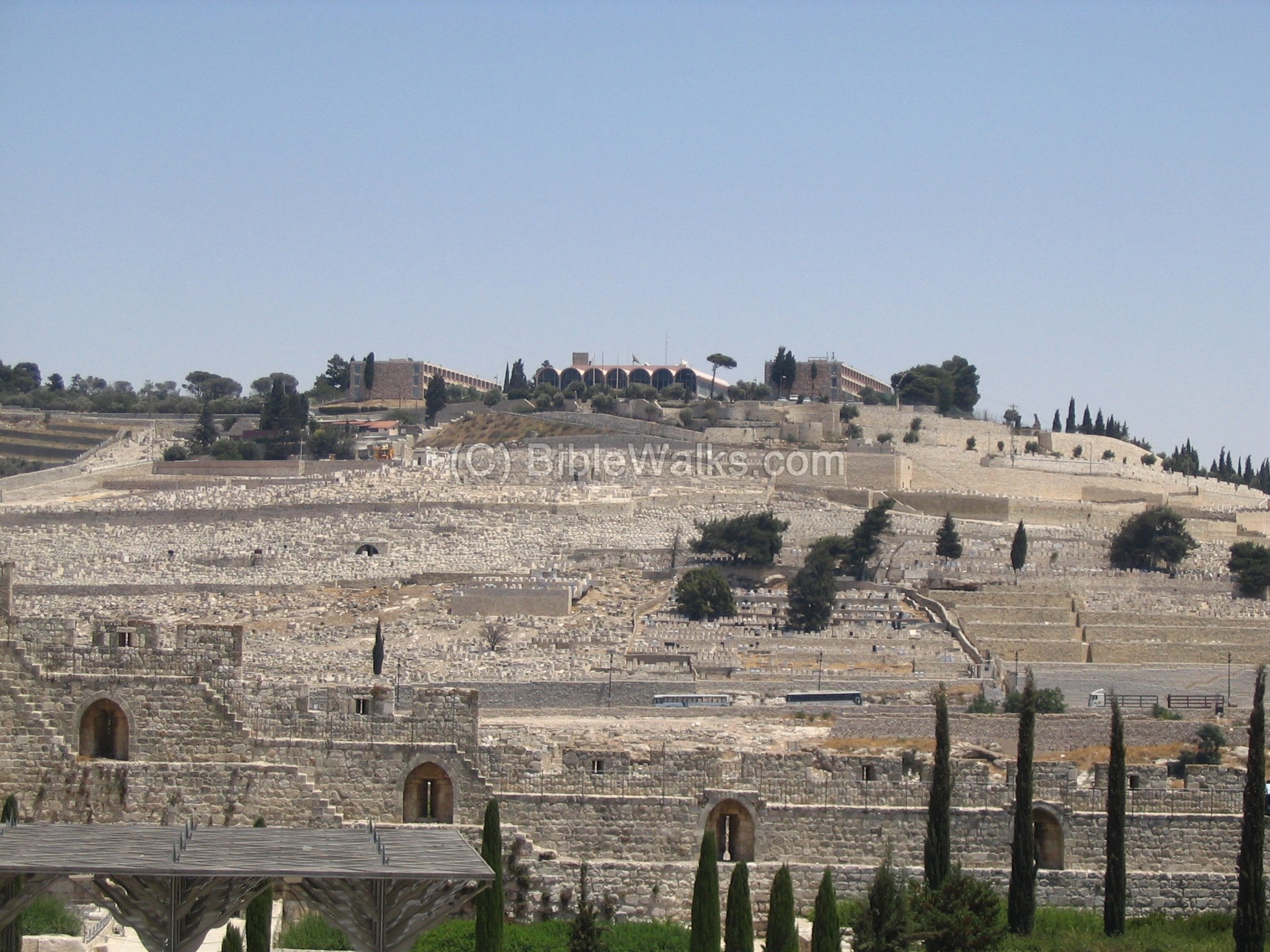

Next we walked down to the Church of Dominus Flevit (which means “the Lord wept”). This site commemorates where Jesus

looked upon Jerusalem and wept. The little chapel at this site is built in the shape of a teardrop, but we were not able to go inside because another group was having Mass while we were there. From a lookout point just in front of the church, Fr. David pointed out the way that Jesus walked during His passion. Jesus began on Mount Zion (from where we were standing, Mount Zion was at the top of the hill across the valley, and to the left of the Old City), where he celebrated the Last Supper in the Upper Room, then He crossed the Kidron Valley to come to the Garden of Gethsemane, where He was arrested. The Kidron Valley is that little valley where the Papal venue was set up for the Mass in Jerusalem. From our vantage point at Dominus Flevit, Gethsemane was just below us. Next Jesus was taken to Caiaphas’s house, back across the Kidron Valley. This is the place we went to with Jimmy, the guide who replaced Fr. David. It was where we saw the dungeon that Jesus would likely have been kept overnight, and where we saw the Holy Stairs. From Caiaphas’s house, Jesus was brought into the Old City where He was brought before Pilate, and
then Pilate sent Him back to Caiaphas’s house, where He was kept overnight in the dungeon that we saw later. And then finally on Friday, Jesus was brought to the place where He began His Via Dolorosa – His Stations of the Cross, that led Him to Calvary now located in the Church of the Holy Sepulchre. We could see this entire path very clearly from where we were standing, at the Church of Dominus Flevit.


Next we walked the “Palm Sunday Road”, down to the Garden of Gethsemane. We took our group picture at this site, right in front of the grove of olive trees. Those olive trees are over 2,000 years old and are sometimes referred to as the “silent witnesses” of Christ's passion, since they were there when He suffered His agony in the garden. The church at Gethsemane is called the Church of All Nations, because many different countries contributed to its construction. It is also sometimes called the church of the Rock of Agony, because right in front of the main altar is the rock that it is believed that Jesus suffered His agony upon.

We then proceeded further down the Palm Sunday road, to the Tomb of Mary. It is believed that she died at the site of Dormition Abbey, across the Kidron Valley, on Mount Zion, but that her body was brought to this site for burial, and then from this site, she was assumed into heaven. To get to the Tomb of Mary, we descended down a long and wide staircase, to a darkened crypt area below, that contained the final resting place of the Mother of God.

Right next door to the Tomb of Mary, is a cave, called the Grotto of Gethsemane (the place where the apostles were a “stone’s throw away” from Jesus when he was suffering His agony in the garden). This cave was a regular meeting place for the apostles and Jesus when they were in Jerusalem, so it was natural that they went there on the night of the Last Supper. This grotto is also called the Grotto of Betrayal, because it is where Judas betrayed Jesus with a kiss. It was in this cave that Jesus was arrested. We celebrated Mass at this site.
Afternoon
In the afternoon we drove to Bethlehem, in the West Bank, through an Israeli checkpoint. First we had lunch at Ruth’s Restaurant, and then we went shopping at a pre-arranged store, Boaz's Field.

After shopping we went to Shepherd’s Field, right next door to the shop. Shepherd’s Field commemorates the place where the Angel appeared to the shepherds and announced to them the birth of the Christ Child.
Then we went to the Church of the Nativity, where Jesus was born. First we stood in line to enter the lower level grotto, where we were able to venerate the place where Jesus was born, which is marked by a silver star underneath an altar. Then we visited the church that is right next door (under the same roof), called St. Catherine’s, which is the Catholic parish of Bethlehem. It is from St. Catherine’s that Midnight Mass in Bethlehem is televised on Christmas Eve.

Next we went downstairs, underneath St.Catherine’s and the Church of the Nativity, to several grotto’s, the most important being the grotto of St. Jerome, where St. Jerome lived for many years and where he translated the Bible from Hebrew and Greek into Latin (called the Vulgate).
Evening
We left the West Bank and returned to Jerusalem. That evening, after dinner, we had a private holy hour in the Church of All Nations, at the Rock of Agony, with the church all to ourselves.
Day 8: Monday, May 11
Morning
Due to uncertainty about the Holy Father’s schedule and how it would impact our ability to get around Jerusalem in the coming days, Fr. David decided that we would spend the entire day walking through and around the Old City of Jerusalem (which normally would not be done all in one day).
We began the day very early (7:30 departure from hotel), and went first to the Western Wall, or Wailing Wall, as it is also sometimes called. The wall is the most sacred site in the world for Jews, because it is the only remaining part of their ancient (Solomon's) Temple that still exists. The Romans destroyed the temple in 70 A.D., and the site where it stood has been occupied by a Moslem shrine (the famous golden-domed structure), called the Dome of the Rock, since the late 7th century. It is called the Dome of the Rock because the shrine is built over a very large rock. For Jews this rock is sacred because they believe it is the site where Abraham was asked to sacrifice his son Isaac (Mt. Moriah), which was the reason that the Jewish people built their temple here. For Moslems this rock is sacred because they believe that it was from this rock that Mohammad made his “night journey” to heaven. Jews call this site “the Temple Mount”, and Moslems call it “Haram al Sharif”, meaning “the Noble Sanctuary”.

Next we walked to the Lion’s gate, also known as St. Stephen’s gate, to the Church of St. Anne, the site where parents of the Blessed Virgin Mary lived and where Mary was born. We venerated a cave in a little crypt area below the main church as the site where this event occurred, and then when we came back upstairs, we were greeted by the beautiful sounds of a group of Nigerian pilgrims singing "How Great Thou Art," in their native tongue. Right next to the church of St. Anne is the Pool of Bethesda, a site where some Gospel events occurred.


We then proceeded to the Chapel of Flagellation, where we were given a cross to carry, so that we could begin our Via Dolorosa, our own Stations of the Cross through the very crowded streets of Jerusalem. We meandered through the streets of the Old City, following the path that Jesus walked on His way to His crucifixion, and we concluded our journey at the Church of the Holy Sepulchre, where we visited the site of Calvary, the slab where His body was anointed when it was taken down from the cross, the tomb where He was laid…and rose from the dead! We also visited a few additional side chapels at the Church of the Holy Sepulchre. We descended down a few flights of stairs to the Chapel of the Holy Cross, where St. Helena found the True Cross. We visited the Chapel of Adam, which lies just below Calvary, and where you can see the rock of Calvary split in two, as was described in the Gospel accounts of Jesus’ crucifixion.

Afternoon
We then had lunch at an outdoor restaurant in the Old City, not far from the Church of the Holy Sepulchre.
After lunch, we walked through the Jewish quarter of the Old City, to reach Zion’s Gate, which we went through to get to Mount Zion. On Mount Zion we first went to the site of the Upper Room, where Polish people from the movement Neocatechumenal Way were singing! They seemed to be following us wherever we went which I did not mind because their language and singing is so beautiful. We moved to an outdoor area to listen to Fr. David speak to us about the Upper Room.

Next we had Mass at the Franciscan chapel in honor of the Blessed Sacrament (the place where we sat around in the enclosed garden area for about 30 minutes before Mass). As Fr. David explained to us, the Franciscans used to be the custodians of the actual Upper Room, but it was taken away from them 500 years ago. Because they did not have access to the Upper Room, they built this little chapel next door to as a place where they could commemorate the events that happened in the Upper Room.
(A side note: the Franciscans have been in intense negotiations with the State of Israel for quite a while now, in an effort to re-acquire ownership of the Upper Room)
After Mass, we walked over to Dormition Abbey, the traditional site where it is believed that the Virgin Mary “fell asleep”. The central focus of the Abbey is the statue of Mary lying down in her final resting position. After this, our final stop of the day, we walked the long way back to the bus, circling around the outside of the huge walls of the Old City.
Day 9: Tuesday, May 12
Morning
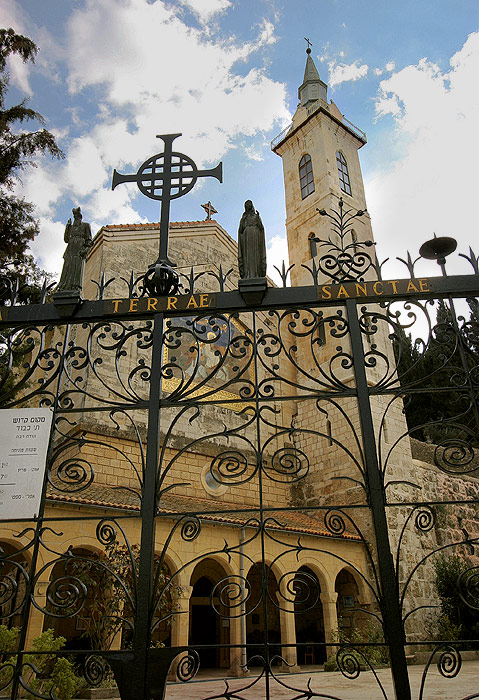
After a very exhausting Monday, we were more leisurely this day. The morning began with a drive to Ein Kerim, where Zacharias, Elizabeth and John lived. First we visited the Church of the Visitation, where Mary went to visit her cousin Elizabeth, and where Mary spoke those famous words of the Magnificat ("My soul proclaims the greatness of the Lord…"). These words are written on many different languages, on tiles that adorn the courtyard of the church. We visited both the lower church and the upper church. Then we walked back down the hill to visit the Church of St. John the Baptist, where we were able to venerate the place where John the Baptist was born, marked with a star underneath a small altar, to the left of the main sanctuary space.

Afternoon
We had lunch in the garden area of a Lebanese restaurant in Ein Kerim. We spent about 4 hours in Ein Kerim.
From Ein Kerim (west of Jerusalem), we drove to Bethany (east of Jerusalem), the town that Martha, Mary and Lazarus lived in and that Jesus frequently visited. Bethany is in the West Bank (though we did not need passports to get in and out of this part of the West Bank, as we did in Bethlehem). Bethany actually lies just on the other side of the Mount of Olives, about a mile or two from the site of Jesus’ Ascension, but there is now a wall that divides it. We had Mass at the church in Bethany. After Mass, we walked up the road a little way, to the site of Lazarus’s tomb, and we descended down into it. As we returned to the bus, there was a man with a camel waiting there for us, and so some of our pilgrims rode the camel. After that, we returned to Jerusalem for dinner.

Evening
Before dinner, some of the group decided to walk to where the Holy Father’s Mass was going to be. The group got as far as Lion’s Gate (also called St. Stephen’s Gate). The gate was blocked off, with Israeli soldiers stationed there. We were told that there was no way to get to the Papal Mass at that point, and no amount of begging changed that!
So the group decided to walk to the Church of the Holy Sepulchre, in hopes of being able to spend more quality time there. When we were there the day before, it was packed with pilgrims, so we were not able to go into the tomb, or touch the rock of Calvary. It was much quieter this evening and we were able to do all those things. Then we walked back to the hotel for dinner.
Day 10: Wednesday, May 13
Morning
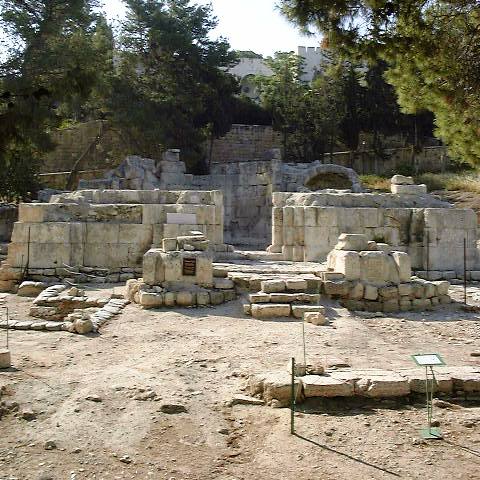
We drove to Emmaus (Nicopolis) in the morning. Fr. David explained to us that there are three different possible sites for the story of the encounter between Jesus and His disciples on the road to Emmaus, and this was one of the possible sites. We had Mass at the beautiful little chapel at this site.
Afternoon
We returned to the hotel after this visit, and then we had to say goodbye to Fr. David. For lunch we split into two different groups. One group went to a pizza place close to the hotel, and the other group went to an outdoor restaurant located in the American Colony hotel, near our hotel.
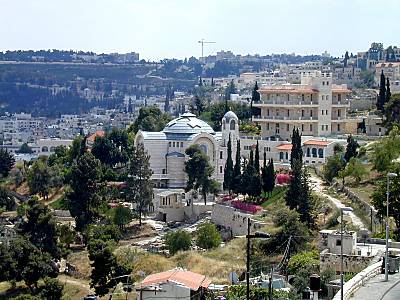
In the afternoon, our new guide Jimmy joined us for the afternoon. First we drove to St. Peter Gallicantu. Gallicantu means the crowing of the cock, and it is called that because it is the site where Peter betrayed Jesus. St. Peter Gallicantu is believed to be location of the house of Caiaphas, and it is believed that Jesus was held here overnight in Caiaphas’ dungeon. We were able to see that dungeon, well intact. We also visited the “Holy Stairs”. These stairs date to well before Jesus’ time, and they were a main route through the city, so, as Jimmy put, “we are not 100% certain that Jesus walked on these stairs, we are 1000% certain that He did." We had to drive a roundabout route to get to St. Peter Gallicantu because the direct roads were still closed due to the Pope’s presence. Because we drove this route, Jimmy was able to point out a few places of Gospel significance that we passed along that route. First he showed us the plot of land that Judas purchased for the 30 pieces of silver that he was given to betray Jesus. It is also believed to be the place where Judas hanged himself after his action. He also pointed out to us the Pool of Salome, where Jesus sent the blind man to wash his eyes in, after he smeared a mixture of mud and spit on his eyes. After St.Peter Gallicantu, we drove over to the Mount of Olives, to visit the Church of the Pater Noster, which commemorates Jesus’teaching His disciples to pray the Our Father. There were over 100 large ceramic plaques with the words of the Our Father written in different languages adorning the walls. Then we returned to the hotel.
Evening
After dinner, we met in the courtyard area of our hotel for an end of the pilgrimage meeting, where we shared about our experiences on this pilgrimage.
Day 11: Thursday, May 14
Morning and Afternoon
Free time to do whatever we wanted.
In the late afternoon, we met at the Franciscan Chapel of the Blessed Sacrament, on Mount Zion, for our last Mass before departure.
After Mass, we went to the Christmas Hotel for a farewell dinner.
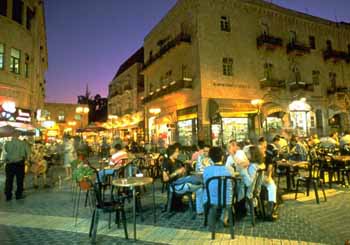
After that, some of the group decided to go to Ben Yehuda Street, partly to check out where the Israeli young people hang out in the evenings, and partly to stay awake for our very early morning departure for the airport.
Day 12: Friday, May 15
Departed Jerusalem at about 2:00 am for our long journey back home.
Saturday, May 30, 2009
Holy Land Pilgrimage May 4-15, 2009 Part I

8 months earlier...on the telephone
Mom: Hi Simi, dad and I are going to Israel next March.
Simone: Okay, have fun!
Mom: Hi Nicki, dad and I are gong to Israel next March.
Nicole: What?! Take me!!!
Mom: Well...
Nicole: Hi Dad! Take me to Israel with you and Mom!
Dad: Okay habibi, whatever you want!
Nicole: Guess what? I'm going to Israel with mom and dad!
Simone: What?! I'm not going to let you go ALONE to the Holy Land!
Simone: Nicole and I are going with you and dad.
Mom: Sigh...
And this is *exactly* how I get taken on trips. I never ask, it just happens via one little sister.
So instead of going in March, my parents changed the trip to a pilgrimage departing in May. My finals ended on Friday. I flew out Saturday to meet my family and our pilgrimage group in Chicago, the departing destination.
Subscribe to:
Posts (Atom)
LinkWithin
